Delegate & Orchestrate Justin Leopard

Agents that act, & the infrastructure that proves it.

I build the connective tissue between planner models, tool-using agents, memory stores, and the humans they report to. Observability, evaluation, trajectory tracing — the boring parts that decide whether a multi-agent system clears a sprint or loops forever. The public path is inspectable: live demo, source repos, and field notes from the harness that ships them.

Currently · JustAi public project and demo

Before · Built Agent-Inc in 2024

Lab · A personal dev harness and public substrate repos

Where this helps

When agents are already in the workflow, but the system is not yet accountable.

The work is not another chatbot layer. It is the operating surface around coding agents: the queue, trace, memory, review, routing, and escalation contract that keeps a team from re-learning the same failure every week.

Diagnostic

Find the expensive loop

Inspect one real run: where it stalled, why it escalated, what context it lost, and which assertion should have caught it.

Build

Instrument the agent lane

Add the task model, trajectory capture, typed memory, review gate, and operator dashboard needed to trust repeated execution.

Policy

Make routing explainable

Separate planner and executor tiers, encode fallback rules, and use prior trajectories to decide when stronger models are justified.

Selected work

Flagship · Public demo

JustAi

An enterprise observability layer for multi-agent engineering teams.

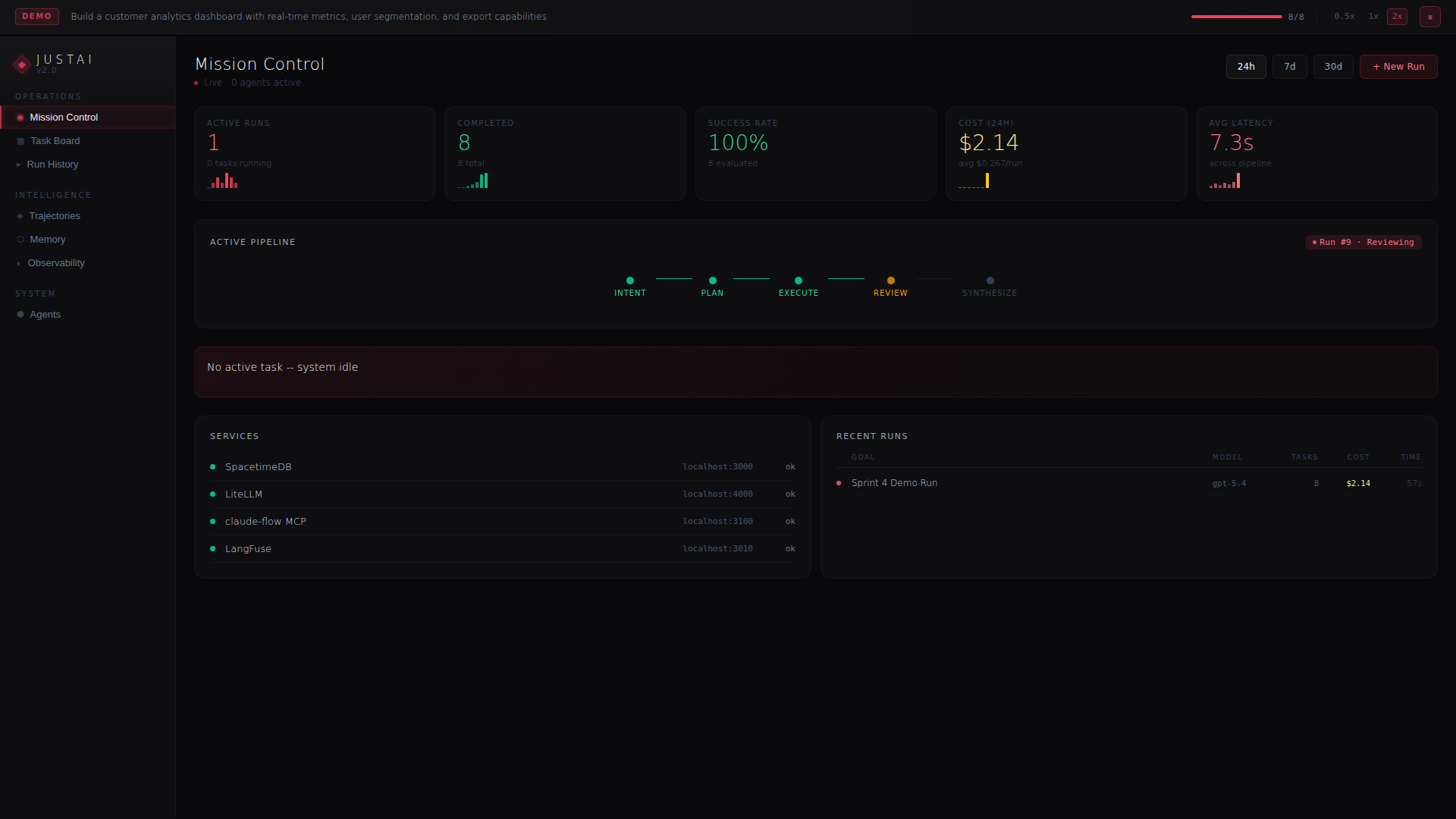
JustAi is a public project and demo: a fleet-observability layer for agents shipping software — planner, executor, reviewer — with cost, latency, trajectories, and learning signals as first-class data. The canonical visitor path is /demo/justai.

source path
Open public repo + demo
sandbox
No login visitor-safe walkthrough
design
Trace-first cost, latency, trajectory

Enter the case study

2026 · Astro · TypeScript · SpacetimeDB · LiteLLM · LangFuse

JustAi Mission Control — active runs, cost, latency, and pipeline state
Mission Control · live pipeline, cost and latency at a glance

Prior work · 2024

Agent-Inc

A tri-agent harness built on intuition, before the literature caught up.

An Observer / Analyzer / Actor loop with an orchestrator underneath. It worked. It also taught me which parts of a multi-agent system are load-bearing and which are aesthetic — the lessons that now shape JustAi.

What I built, what broke, what I learned

2024 · Python · OpenAI · local tools

Agent-Inc tri-agent architecture Three agents — Observer, Analyzer, and Actor — connected in sequence, with an orchestrator coordinating them and a feedback loop from Actor back to Observer. Agent 01 Agent 02 Agent 03 Observer Analyzer Actor Watches · listens Plans · reasons Writes · executes context plan Orchestrator · coordination plane Intent › schedule › handoff › trace Feedback · outcome signal

Public substrate

Public substrate

Minimal public references for the moving parts of an agent harness.

The *-mini family — minimal, MIT, well-tested public references for the moving parts of an agent harness. safe-mini (safety reference), lab-mini (data-science labbing), route-mini (multi-provider LLM routing with fallback), memory-mini (durable agent memory).

Read the harness sketch

2026 · MIT public references · active substrate

About

Software engineer, ten-plus years. The last two have been spent building agent systems that survive contact with real work — the kind where cost, trajectory, and escalation logic matter more than a clever prompt.

I read the papers the week they drop, then ship them as infrastructure the week after. More about how I work →